Now Reading: Country Eggs: Detailed Information, Nutrition, Benefits, Risks, and How They Compare With Farm Eggs
-
01
Country Eggs: Detailed Information, Nutrition, Benefits, Risks, and How They Compare With Farm Eggs
Country Eggs: Detailed Information, Nutrition, Benefits, Risks, and How They Compare With Farm Eggs

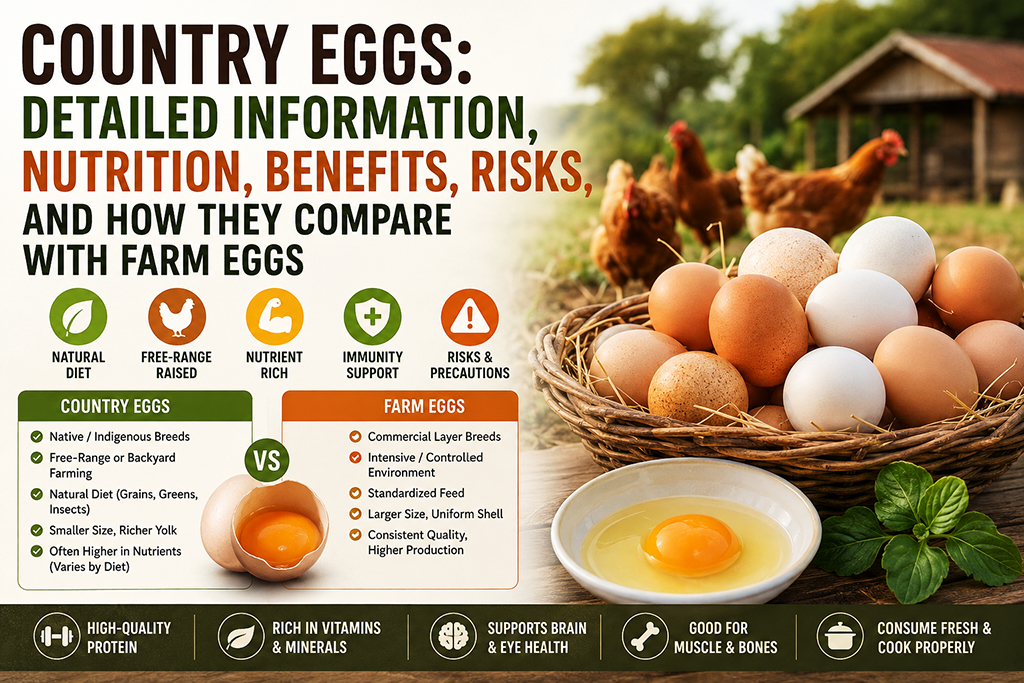
Country eggs, often called desi eggs, village eggs, native chicken eggs, or free-range eggs, are eggs produced by chickens raised under traditional or less-intensive farming conditions. In India, the term “country egg” commonly refers to eggs from indigenous or backyard-raised chickens, although the exact farming method can vary.
1. What are country eggs?
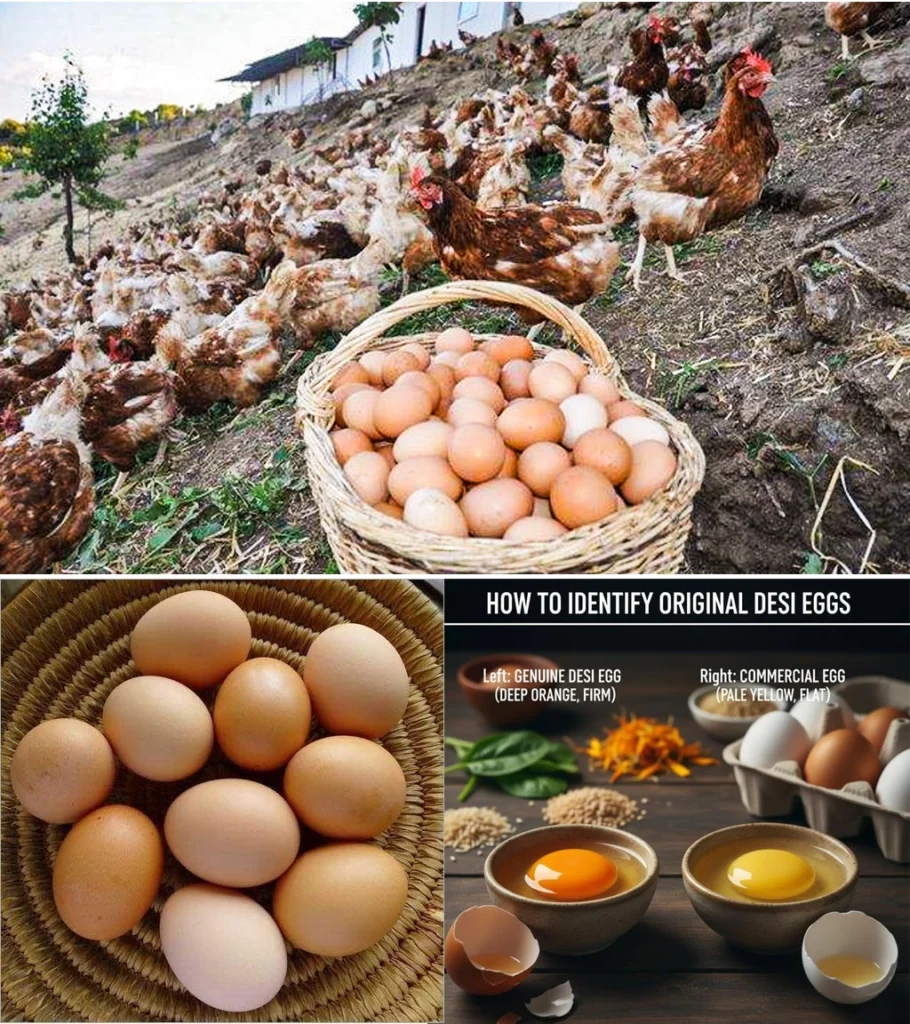
Country eggs generally come from chickens that may:
- Be indigenous or native breeds
- Have access to outdoor areas
- Eat a mixture of grains, seeds, insects, greens and other natural foods
- Be raised in backyard or small-scale farms
- Produce fewer eggs than commercial layer chickens
The shell can be white, cream, brown, light brown, or even slightly tinted, depending primarily on the breed.
Importantly, brown shell does not automatically mean an egg is a country egg, and shell colour does not by itself determine nutritional quality.
2. Country eggs vs. commercial eggs
The major difference is usually the breed and production system, rather than the shell colour.
| Feature | Country/Desi Egg | Commercial Egg |
|---|---|---|
| Chicken breed | Often indigenous/native | Usually commercial layer breeds |
| Production | Backyard/small-scale or free-range | Large-scale poultry farms |
| Egg size | Often smaller | Usually larger and more uniform |
| Shell | Variable | Usually uniform |
| Yolk colour | Often deeper yellow/orange | Usually yellow, depending on feed |
| Production volume | Lower | Higher |
| Price | Usually higher | Usually lower |
| Nutrition | Generally nutritious | Generally nutritious |
| Protein | High-quality protein | High-quality protein |
| Vitamin/mineral content | Can vary | Can vary |
A key point
Country eggs are not automatically dramatically more nutritious than commercial eggs.
The hen’s diet, breed, age, health, living conditions and production system can influence nutrient composition. A darker yolk is also not reliable proof that an egg contains substantially more nutrients.
3. Nutritional value of country eggs
An egg is one of the most nutrient-dense foods available.
A typical large chicken egg provides approximately:
- 70–80 calories
- 6–7 g protein
- 5 g fat
- Around 1.5–2 g saturated fat
- Vitamin B12
- Riboflavin (B2)
- Selenium
- Choline
- Iodine
- Vitamin A
- Small amounts of vitamin D
- Folate
- Phosphorus
The exact nutritional value varies with egg size and the hen’s diet.
Protein
Egg protein contains all nine essential amino acids, making it a complete protein.
This is particularly useful for:
- Muscle maintenance
- Muscle recovery
- Supporting healthy ageing
- Maintaining strength
- Supporting tissue repair
4. Benefits of country eggs
4.1 Supports muscle health
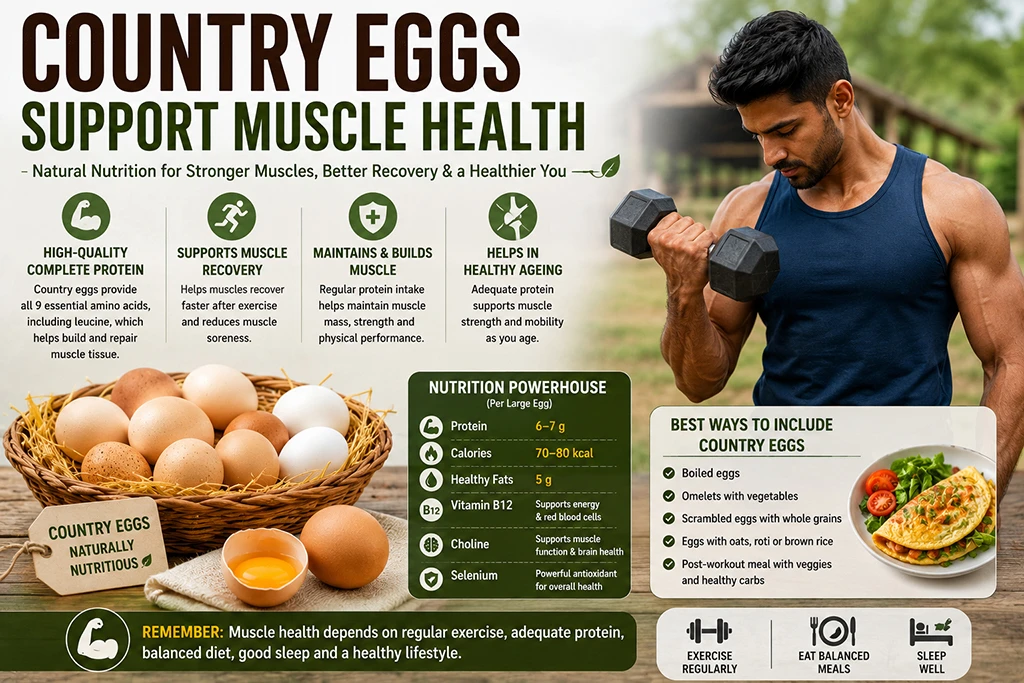
Eggs provide high-quality protein containing essential amino acids.
Including eggs as part of a balanced diet can help support:
- Muscle maintenance
- Recovery after exercise
- Strength
- Healthy ageing
However, eating country eggs alone will not build muscle. Adequate total protein and resistance exercise are also important.
4.2 Supports brain health
Egg yolks are particularly rich in choline.
Choline is important for:
- Cell membranes
- Normal nervous-system function
- Production of acetylcholine, a neurotransmitter
- Normal brain development
Eggs are one of the more convenient dietary sources of choline.
4.3 Provides vitamin B12
Eggs contain vitamin B12, which contributes to:
- Normal red blood cell formation
- Nervous-system function
- DNA synthesis
- Normal energy metabolism
However, eggs alone may not provide enough B12 for someone with a significant deficiency.
4.4 Supports eye health
Egg yolks contain carotenoids including lutein and zeaxanthin.
These compounds accumulate in the retina and are associated with eye health.
Regular consumption of eggs as part of a balanced diet can therefore contribute useful amounts of these nutrients.
4.5 Provides selenium
Eggs are a useful source of selenium, an essential trace mineral involved in:
- Antioxidant defence
- Thyroid hormone metabolism
- Immune function
- Protection of cells from oxidative damage
4.6 May help with satiety
Because eggs provide protein and fat, they can be relatively filling.
For example, having an egg with vegetables at breakfast may help create a more satisfying meal than eating a breakfast consisting primarily of refined carbohydrates.
This can be useful when managing overall calorie intake.
5. Is the country egg yolk better?
You may notice that country eggs sometimes have a deep yellow or orange yolk.
This can happen because of the hen’s diet.
Foods containing carotenoid pigments—such as certain greens, corn and other plant materials—can influence yolk colour.
Therefore:
Orange yolk ≠ automatically more nutritious egg.
Yolk colour can indicate differences in diet, but it isn’t a reliable standalone measure of overall nutritional quality.
6. Are country eggs better for immunity?
Eggs provide several nutrients involved in normal immune function, including:
- Protein
- Selenium
- Vitamin A
- Vitamin B12
- Vitamin D in small amounts
- Zinc in smaller quantities
Therefore, eggs can contribute to a healthy immune-supporting diet.
But it would be inaccurate to claim that country eggs boost immunity dramatically or prevent infections.
A strong immune system depends on overall nutrition, sleep, physical activity, vaccination where appropriate, and general health—not one particular food.
7. Country eggs and cholesterol
This is one of the most misunderstood aspects of eggs.
Egg yolks contain dietary cholesterol.
However, dietary cholesterol does not affect blood cholesterol in exactly the same way for everyone. The overall dietary pattern, particularly saturated and trans fat intake, is also important.
For many healthy people, eggs can be included as part of a balanced diet.
People with:
- High LDL cholesterol
- Cardiovascular disease
- Diabetes
- Familial hypercholesterolemia
may need more individualized dietary advice.
If you have a medical condition affecting cholesterol or blood sugar, your doctor or registered dietitian can determine an appropriate egg intake based on your overall diet and laboratory results.
8. Can people with diabetes eat country eggs?
Generally, eggs contain very little carbohydrate, so they usually have a relatively small direct effect on blood glucose.
An egg can therefore be incorporated into many diabetes-friendly meals.
However, the way the egg is prepared matters.
Better choices
- Boiled egg
- Poached egg
- Egg with vegetables
- Scrambled egg using minimal oil
Less favourable choices
- Deep-fried egg
- Egg cooked with large amounts of butter/ghee
- Egg served with highly refined carbohydrates
- Egg combined with processed meats
The overall meal matters more than simply choosing a country egg over a commercial egg.
9. Country eggs for weight loss
Country eggs can be useful in a weight-management diet because their protein content can help with satiety.
For example:
Breakfast
2 eggs + vegetables + a moderate portion of whole-grain food
can provide a more balanced meal than:
Large portions of refined carbohydrates + sugary beverages.
But country eggs are not a weight-loss food by themselves.
Weight loss ultimately depends largely on maintaining an appropriate energy balance while getting adequate protein, fibre and micronutrients.
10. Are country eggs good for children?
Eggs can be an excellent food for children because they provide:
- Protein
- Choline
- Vitamin B12
- Selenium
- Vitamin A
- Other micronutrients
Eggs should be properly cooked, particularly for young children, to reduce the risk of foodborne illness.
For infants, introduction of eggs should follow age-appropriate complementary feeding guidance and take individual allergy considerations into account.
11. Are country eggs good for older adults?
Eggs can be particularly useful in older adults because maintaining adequate protein intake becomes increasingly important for preserving muscle mass and strength.
A balanced diet containing eggs alongside:
- Fish
- Lean meat
- Milk/curd
- Pulses
- Beans
- Nuts and seeds
can help provide a variety of protein sources.
12. Raw country eggs: Are they safe?
Eating raw or undercooked eggs carries a risk of Salmonella infection.
The risk is particularly concerning for:
- Pregnant women
- Young children
- Older adults
- People with weakened immune systems
Safer practice is to cook eggs until the white and yolk are firm, unless using eggs specifically treated/pasteurized for preparations that require raw or lightly cooked eggs.
Washing eggs immediately before storage is also generally not recommended because it can remove the shell’s protective coating and potentially facilitate bacterial entry.
13. How many country eggs can you eat?
There is no single number that is ideal for everyone.
Your appropriate intake depends on:
- Age
- Total calorie intake
- Protein requirements
- Blood lipid profile
- Diabetes status
- Cardiovascular health
- Overall dietary pattern
For a healthy adult, eggs can generally be part of a balanced diet, but the whole dietary pattern is more important than whether the egg is labelled “country.”
14. Country egg vs. chicken egg: Is there a difference?
Technically, a country egg is also a chicken egg.
The distinction usually refers to how the chicken was raised and sometimes to the breed.
A country egg may be:
- Smaller
- Less uniform
- Produced by indigenous breeds
- From free-ranging/backyard chickens
while a commercial egg is typically produced by specialized laying breeds in a controlled production system.
15. Does a brown shell mean a country egg?
No.
Shell colour is primarily determined by genetics and breed.
A commercial chicken can produce brown eggs, while a native chicken can produce eggs with different shell colours.
Therefore, you should not identify a country egg solely by looking at the shell.
16. How to identify genuine country eggs
There is no perfectly reliable visual test.
Instead, consider:
1. Source
Buy from a reputable farmer, producer or retailer who can explain the production system.
2. Size
Country eggs are often smaller, but size alone doesn’t prove authenticity.
3. Shell appearance
Country eggs may have more variation in size and shell colour, but this isn’t definitive.
4. Price
They are often more expensive because indigenous chickens generally produce fewer eggs. However, a high price does not prove authenticity.
5. Labelling
Look for credible information about:
- Breed
- Farming method
- Feed
- Certification
- Producer
17. Are country eggs more nutritious than commercial eggs?
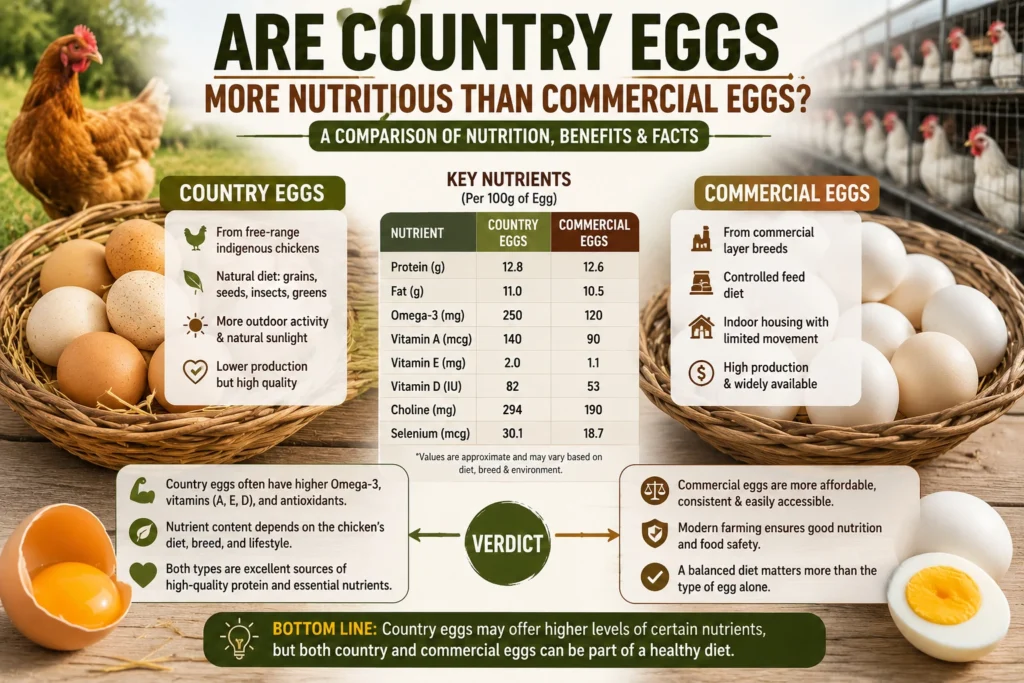
The answer is sometimes, but not necessarily.
Some studies have found differences in nutrients such as omega-3 fatty acids, vitamin E or carotenoids depending on the hen’s feed and production system.
But these differences are not universal.
For example, a commercial egg from a hen fed a nutritionally optimized diet may have a nutrient profile that is equal to or better than that of a particular backyard egg.
Therefore:
The hen’s diet and production conditions matter more than the marketing label alone.
18. Country eggs and omega-3 fatty acids
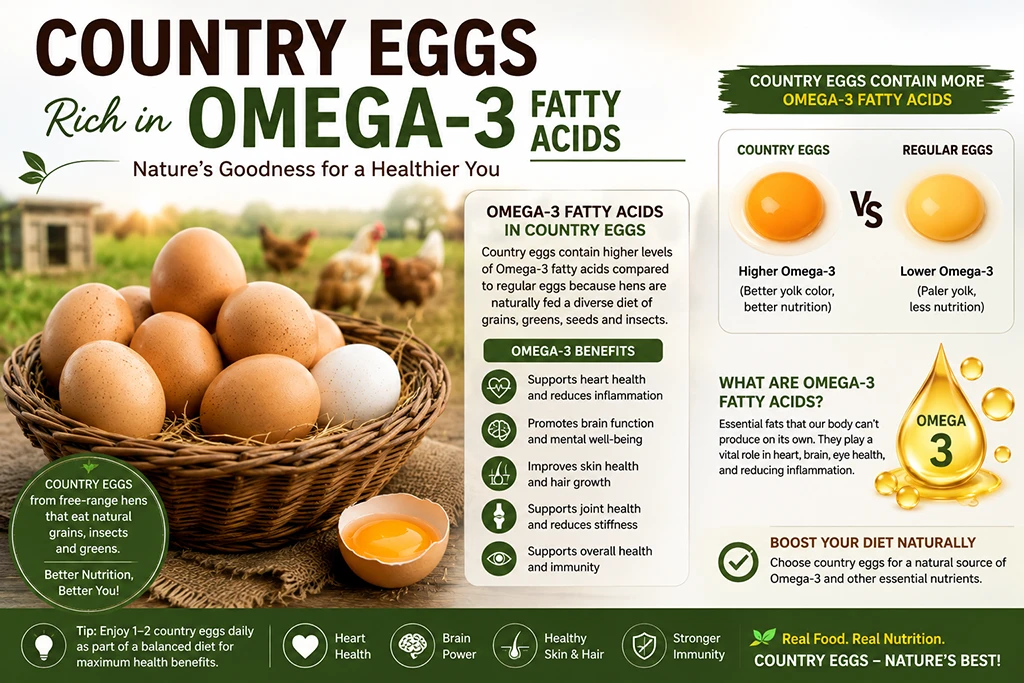
The amount of omega-3 in an egg can be influenced substantially by the hen’s diet.
Hens whose feed contains ingredients such as flaxseed or other omega-3-rich sources can produce eggs with higher omega-3 content.
Therefore, if your goal is specifically to increase omega-3 intake, look for eggs that are verified or labelled as omega-3 enriched, rather than assuming every country egg contains high omega-3 levels.
19. Best ways to cook country eggs
Boiled
One of the simplest methods.
Advantages:
- No additional cooking oil
- Convenient
- Easy to portion
Poached
Uses water rather than significant added fat.
Scrambled
Can be nutritious when combined with vegetables and prepared with a modest amount of oil.
Omelette
An excellent way to add:
- Onion
- Tomato
- Spinach
- Capsicum
- Mushrooms
- Other vegetables
Fried
Still provides protein and nutrients, but the nutritional profile of the overall meal depends on the amount and type of cooking fat used.
20. Country eggs and hair health
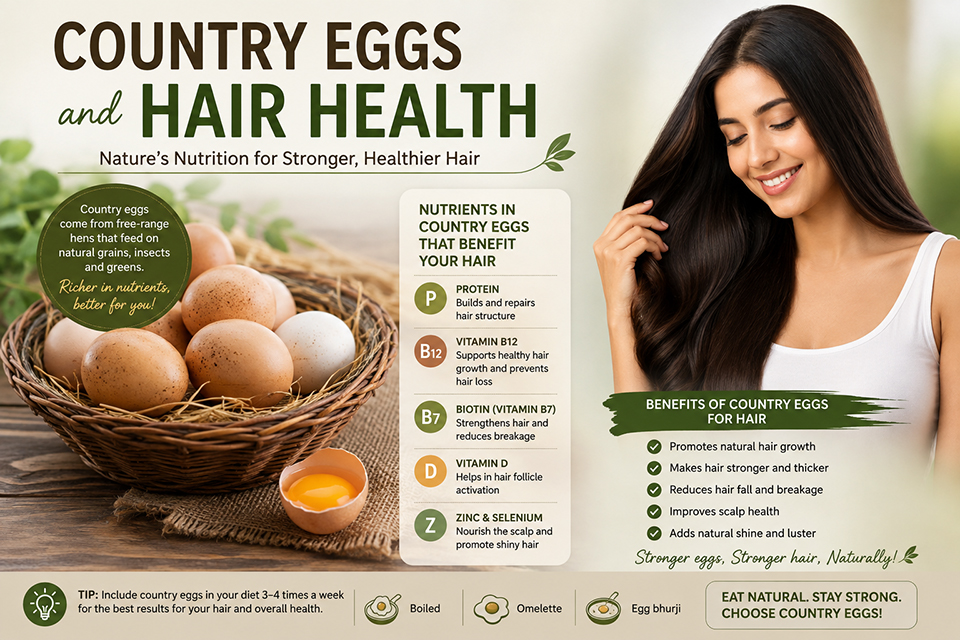
Eggs provide nutrients involved in normal hair and skin biology, particularly:
- Protein
- B12
- Biotin
- Selenium
- Vitamin A
However, eating eggs does not automatically make hair grow faster.
Hair loss can have many causes, including nutritional deficiencies, thyroid disorders, hormonal factors, genetics and scalp conditions.
If hair loss is persistent, identifying the underlying cause is more useful than simply increasing egg consumption.
21. Possible disadvantages
Country eggs are nutritious, but they are not universally superior or risk-free.
Potential concerns include:
Foodborne infection
Improperly handled or undercooked eggs can carry bacteria such as Salmonella.
Higher cost
Country eggs are often more expensive.
Variable nutrition
Nutrient composition can vary significantly depending on the hen’s feed and farming conditions.
Misleading marketing
Some products may be marketed as “desi,” “organic,” or “country” without providing meaningful evidence of the production system.
Cholesterol considerations
People with particular cardiovascular or metabolic conditions may need individualized advice about egg consumption.
22. How to include country eggs in a healthy diet
A practical meal could be:
Breakfast
- 1–2 boiled eggs
- Vegetable salad
- Whole-grain roti or a small portion of oats
- Unsweetened tea/coffee
Lunch
- Vegetables
- Dal
- Brown rice or roti
- Curd
Dinner
- Egg/lean protein
- Plenty of vegetables
- Moderate whole-grain carbohydrate
The important point is to build a balanced diet, rather than relying on country eggs as a “superfood.”
Country eggs: Bottom line
Country eggs are a nutrient-dense source of high-quality protein, choline, vitamin B12, selenium and other micronutrients. They can be an excellent addition to a balanced diet.
However, several popular claims need to be treated cautiously:
- Brown shell does not prove an egg is a country egg.
- Orange yolk does not automatically mean superior nutrition.
- Country eggs are not necessarily dramatically healthier than commercial eggs.
- The hen’s breed, feed and production system influence nutritional composition.
- Proper cooking and food hygiene are important.
If you are choosing between country and commercial eggs, freshness, food safety, trustworthy sourcing, affordability and your overall diet are more important than the label alone.
Related Posts



Stay Informed With the Latest & Most Important News
Previous Post
Next Post











Advertisement

-
 01Boost your gut health and immune system naturally
 -
 02Regenerative Stem Cell Treatments in Orthopedics: A Complete Guide to Healing Joints, Bones, and Soft Tissues Naturally
 -
 03Can You Get Vitamin D3 During Sunrise or Sunset? A Scientific Guide
 -
 04The Ultimate Guide to Making Sesame Seed Milk: Recipe, Nutrition & Amazing Health Benefits
 -
 05Country Eggs: Detailed Information, Nutrition, Benefits, Risks, and How They Compare With Farm Eggs
 -
 06Extraordinary Lasoda Glue Berry: Health Benefits, Nutrition, and Traditional Uses
 -
 07Seasonal mushrooms and snake hole mushrooms: A complete guide